

What’s New in Dynamics 365 and Power Platform: 2026 Release Wave 1 Highlights
What’s New in Dynamics 365 and Power Platform: 2026 Release Wave 1 Highlights
March 19th, 2026
8 min read
The 2026 Release Wave 1: A Shift Toward Agentic AI
Microsoft published the 2026 Release Wave 1 plans on 18 March 2026, covering Dynamics 365, Power Platform, and role‑based agents in Microsoft 365 Copilot. As with every Wave 1 release, features will roll out gradually between April and September 2026, following Microsoft’s standard release cadence for the platform.
This wave marks a clear step forward in Microsoft’s AI strategy. The focus moves beyond assistive AI toward more autonomous, agentic systems that can take meaningful action across business processes.
Key themes highlighted by Microsoft:
- Agentic AI that can take action, not just provide suggestions
- Deeper automation across business processes
- Improved data grounding for more accurate, context‑aware insights
- Enhanced governance to support safe, scalable AI adoption
Alongside these themes, this release introduces capabilities designed to help teams work faster, make better decisions, and deliver more connected customer experiences, underpinned by increasingly unified, real‑time customer data.
Note: This overview includes selected highlights from Microsoft’s Release Planner, which outlines planned features subject to change. For full details on all planned features across Dynamics 365, Power Platform and Copilot, visit the official Microsoft Release Plans here.
AI Agents and Copilot Studio
AI agents and Copilot Studio sit at the centre of this release, with expanded capabilities across Dynamics 365, Power Platform, and Microsoft 365 Copilot.
Key Highlights
- More capable agentic behaviours that can take multi‑step actions, allowing agents to complete tasks and workflows on behalf of users.
- Improved lifecycle management for testing, deploying, and monitoring agents at scale, supporting reliable enterprise adoption.
- Richer data grounding through deeper Dataverse, API, and system connections, enabling more accurate, context‑aware insights.
- Multi‑agent orchestration and customisation for complex workflows, helping teams coordinate multiple agents efficiently.
- Stronger governance and evaluation tools to ensure responsible scaling and oversight of AI agents.
Why this matters
AI agents are becoming foundational across Microsoft’s business applications. These updates improve reliability, strengthen governance, and expand the ability to automate multi‑step processes across systems.
Persona use case example:
A sales manager can deploy multiple AI agents to monitor pipelines, flag emerging risks, and automatically suggest next steps, freeing reps to focus on strategic client interactions.
Automation and Governance (Power Automate and Platform Management)
Automation and governance remain major priorities, aligning with Microsoft’s broader direction across Dynamics 365 and the Power Platform.
Key Highlights
- Expanded governance and oversight with more granular controls.
- Improved AI‑driven automation, with Copilot suggesting and generating more advanced flows.
- Integration with agentic workflows, enabling agents to trigger and adjust automated processes.
- Self‑healing desktop flows, which detect and resolve errors automatically to reduce manual intervention.
Why this matters
Scaling automation without governance can introduce risk. These updates strengthen enterprise‑wide controls while enabling more resilient, intelligent automation.
Persona use case example:
An operations lead can trust that automated workflows detect and resolve transient issues without manual intervention, ensuring approvals, notifications, and data updates continue flowing smoothly.
Sales (Dynamics 365 Sales)
Dynamics 365 Sales sees significant investment in AI‑driven selling and agent‑supported workflows.
Key Highlights
- More proactive Copilot insights that identify risks, recommend next‑best actions, and surface customer signals. These AI‑driven recommendations monitor deals and engagement activity in real time.
- Sales Development Agent to support pipeline creation and qualification workflows, helping reduce manual data entry and accelerate lead progression.
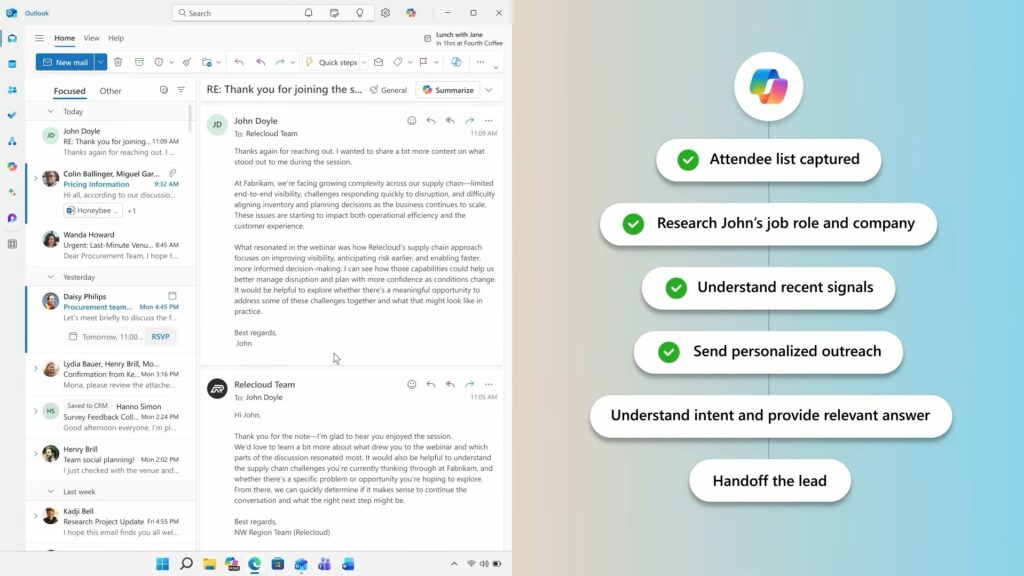
- Sales Research Agent to enrich opportunities with contextual insights, saving sellers time on research.
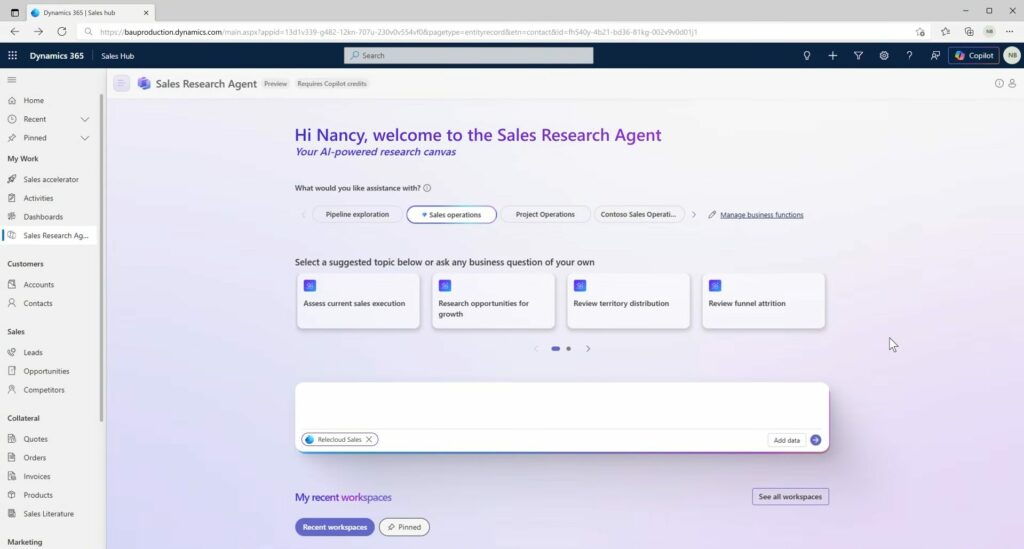
- Enhanced Sales Agent in Microsoft 365 Copilot, acting as a central workspace for sellers by bringing together CRM data, communications, and suggestions in one place.
Sellers also benefit from:
- Configurable record summaries
- Contextual support in Outlook and Teams
- Improved email and meeting intelligence
Why this matters
These updates help reduce manual effort, enabling sales teams to focus on high‑value conversations, close deals faster, and improve pipeline accuracy.
Persona use case example:
A field sales rep receives a Copilot notification highlighting a high‑priority opportunity, with suggested next steps and pre‑populated notes, enabling them to act immediately while on the road.
Customer Service (Dynamics 365 Customer Service)
Customer Service enhancements focus on improving resolution speed, consistency, and operational visibility.
Key Highlights
- More capable Copilot for case summarisation and guidance, delivering richer summaries and actionable insights.
- Agentic case management and workflows across routing, intent detection, and resolution, supporting seamless case handling.
- Quality Evaluation Agent to automatically review interactions and help identify coaching opportunities.
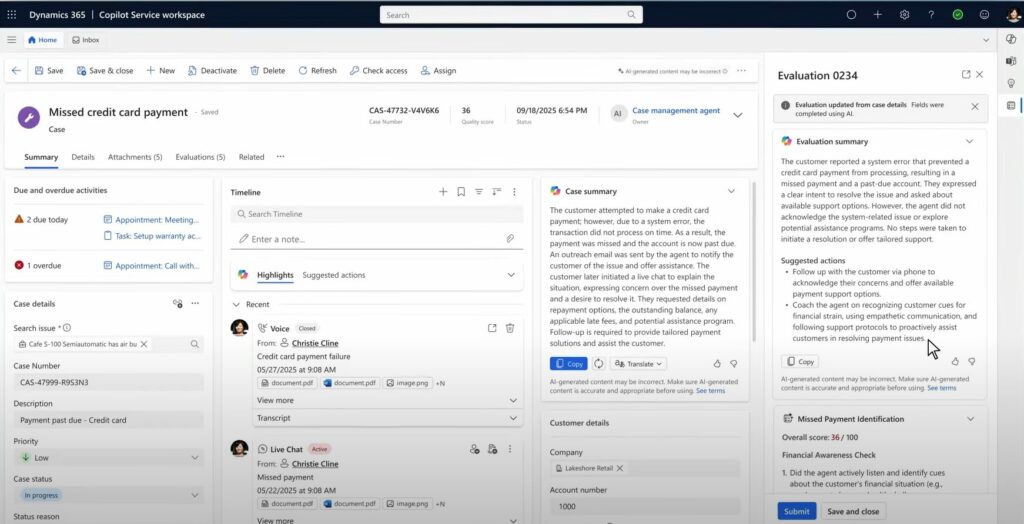
- Smarter knowledge retrieval based on customer context.
- Contact Center enhancements across self‑service, assisted service, channels, and supervisor insights.
- Enhanced supervisor and admin tooling to improve oversight and performance management.
Why this matters
These updates help teams handle cases more efficiently, reduce manual effort, and ensure consistent, high‑quality customer interactions.
Persona use case example:
A service agent can summarise a complex case with Copilot in seconds, freeing them to focus on resolution, while supervisors track team performance and spot coaching opportunities through real‑time dashboards.
Customer Engagement and Marketing
Customer Insights acts as the data and orchestration layer for personalised, agent‑driven engagement across sales, service, and marketing.
Key Highlights
- Copilot‑powered conversational SMS: Enables two‑way messaging through Copilot Studio agents, moving beyond keyword‑based communication and allowing campaigns to adapt based on responses.
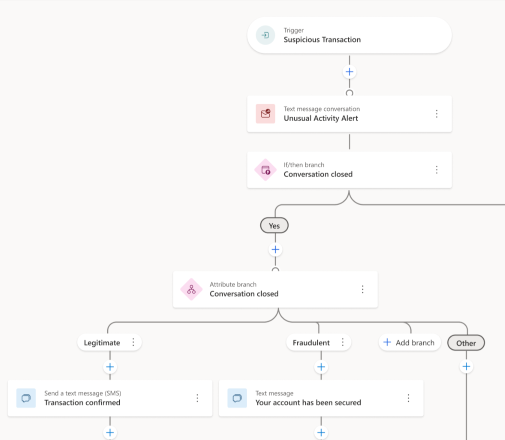
- Customer Insights – Journeys: Expands agentic orchestration across sales, marketing, and service, enabling AI‑driven engagement at multiple touchpoints.
- Customer Insights – Data: Reinforces real‑time data unification and enrichment, supporting accurate insights and proactive decision‑making.
Why this matters
These capabilities allow teams to deliver more relevant, responsive, and connected experiences across the customer lifecycle.
Persona use case example:
A marketing manager creates a campaign that adapts automatically to customer interactions, while service and sales agents receive contextual signals in real time, ensuring coordinated engagement across the organisation.
Field Service (Dynamics 365 Field Service)
Field Service updates focus on intelligent scheduling, technician productivity, and improved coordination between planning and execution.
Key Highlights
- AI‑driven scheduling and decision‑making through the Scheduling Operations Agent.
- Enhanced mobile experience, supporting more complex workflows on the go.
- Predictive work order intelligence to identify risks or delays before they occur.
- Stronger end‑to‑end execution across service delivery and assets.
Why this matters
These updates strengthen the connection between planning and execution, improving efficiency and service quality in the field.
Persona use case example:
A field technician receives an AI‑suggested schedule prioritising jobs by urgency and skillset, helping them complete tasks more efficiently.
Project Operations (Dynamics 365 Project Operations)
Project Operations continues to evolve with improvements to project visibility, resource planning, and operational control, alongside closer alignment with AI‑driven insights and automation.
Why this matters
These enhancements support better decision‑making, improved resource utilisation, and stronger alignment between project delivery and wider business objectives.
Persona use case example:
A project manager can use AI‑informed resource allocation suggestions to avoid bottlenecks and keep projects on track.
App Creators (Power Apps and Power Pages)
Power Apps and Power Pages continue to evolve as AI‑first, low‑code development platforms.
Key Highlights
- Generative app creation improvements for more complete builds from natural language.
- Refreshed model‑driven UI for a modernised experience.
- Offline‑first canvas apps with real‑time Dataverse access.
- Generative pages with expanded capabilities.
- Power Pages security and governance enhancements, including security agent improvements.
Why this matters
These updates help teams design, build, and manage secure, scalable solutions faster, even without deep technical expertise.
Persona use case example:
An app maker can generate a customer feedback portal using natural language input, connect it to Dataverse, and deploy it securely within hours instead of days.
Moving Toward Autonomous, Governed, AI‑Powered Business Systems
The 2026 Release Wave 1 highlights a clear direction from Microsoft. AI agents, automation, and governance are becoming foundational across Dynamics 365 and the Power Platform.
This release helps organisations:
- Automate more work with confidence
- Build more connected and intelligent solutions
- Empower teams with proactive, data‑driven insights
- Govern AI and automation effectively at scale
If you’d like to explore how these updates could support your organisation, contact the team at info@pragmatiq.co.uk or call 01908 038 110.
Want to keep in touch?
Sign up to our newsletter for regular updates.
"*" indicates required fields