

Why visibility gets harder as you grow (and what leading networks do differently)
Why visibility gets harder as you grow (and what leading networks do differently)
September 25th, 2026
7 min read
Growth should give organisations greater visibility, not less.
But for many business networks, chambers, membership organisations and programme-led organisations, the opposite can happen. As the organisation grows, so does the number of programmes, events, funding streams, partners and organisations it works with. More activity creates more information, but it doesn’t necessarily create a clearer picture of what’s happening.
Before long, questions that should be relatively straightforward become surprisingly difficult to answer. Which organisations are engaging across multiple programmes? Which initiatives are creating the greatest impact? Are we reaching the same organisations repeatedly, or engaging new ones? What outcomes are we delivering across our activity?
Leaders know activity is taking place, but can struggle to see the full picture. Reporting becomes more manual, opportunities can be missed, and demonstrating impact to funders, partners and stakeholders becomes more difficult.
The data may exist. The challenge is being able to connect it.
That’s why what looks like a reporting problem is often something bigger: a visibility problem created by growth.
Growth creates more information – but not necessarily more visibility
Growth is a positive thing. More organisations are engaging with you, more programmes are being delivered and more opportunities are being created.
The challenge is that growth rarely happens in one direction. A business network might introduce new initiatives alongside existing programmes. Events can bring in new organisations and contacts, while funding streams create additional reporting requirements. Different teams, partners or external providers may also capture information in different ways.
Over time, what started as a manageable set of activities can become a much more complicated picture to maintain. Information may be spread across a CRM, event platform, spreadsheets, shared documents and individual team processes. Each source may work well for its own purpose. However, bringing everything together to understand the bigger picture becomes increasingly difficult.
The challenge isn’t the amount of activity. It’s being able to understand that activity as a whole.
The warning signs usually appear in day-to-day work
You may not initially describe this as a visibility problem. Instead, it tends to show up through practical frustrations:
- Reporting takes longer than it used to. Teams spend more time pulling information together, checking figures and preparing reports.
- Information lives in multiple places. Different teams or programmes maintain their own records, making it difficult to establish which information is current.
- Teams spend time validating data. Before a figure can be used, someone has to check where it came from and whether it can be trusted.
- Questions involving multiple programmes are difficult to answer. You can report on individual activities, but understanding how they connect is much harder.
- Leadership reporting becomes a manual exercise. Producing a clear picture of performance relies on people bringing information together rather than the information being readily available.
These aren’t necessarily signs that an organisation is doing something wrong. They can simply indicate that the organisation has grown beyond the processes and systems that once worked well.
Visibility isn’t just a reporting challenge
When visibility starts to decline, reporting is often where the problem becomes most obvious. The consequences, however, can extend much further.
When information about organisations, programmes and engagement is fragmented, teams can find it harder to identify opportunities, understand engagement trends and allocate resources effectively. Leadership teams may have access to plenty of information but still lack confidence in the bigger picture.
For organisations working across multiple programmes, this can be particularly significant. The same organisation might attend an event, participate in a funded programme and engage with another initiative. If each interaction is represented in a different place, it becomes difficult to understand the full relationship.
The result is that what begins as a reporting challenge can quickly become a decision-making challenge.
Without a connected view, it becomes harder to answer questions such as:
- Which organisations are most engaged with our activity?
- Where are there opportunities to deepen those relationships?
- Which programmes are reaching the organisations they were intended to support?
- What outcomes are we delivering across the organisation as a whole?
These aren’t simply reporting questions. They’re questions about how effectively the organisation understands its own activity.
What leading networks do differently
Organisations that maintain visibility as they grow tend to focus on how information works across the organisation, rather than treating reporting as a standalone requirement.
They build a connected view of organisations and relationships
For networks, chambers and membership organisations, the relationship is often more important than the individual interaction.
An organisation that attended an event, participated in a funded programme and engaged with another initiative isn’t three separate records of activity. It’s one relationship with a much richer history.
Connecting that information makes it easier to understand engagement, identify patterns and spot opportunities that might otherwise be missed.
They create consistent processes
Connected information depends on consistent ways of capturing it. If different programmes collect information in different formats or rely on separate processes, bringing that information together later becomes difficult.
More consistent processes make information easier to maintain, compare and use as the organisation continues to grow.
They focus on meaningful reporting
Good reporting isn’t about producing more dashboards. It’s about being able to answer the questions that matter.
That might mean understanding which programmes are delivering the strongest engagement or identifying organisations participating across multiple initiatives. It could also mean demonstrating outcomes to funders or giving leadership teams a clearer view of performance.
The starting point isn’t “What reports should we build?” but “What do we need to understand?”
Where technology fits
Technology can play an important role, but it shouldn’t be the starting point.
The objective isn’t to introduce another system simply because an organisation has outgrown its spreadsheets. It is to create a better way of connecting information and supporting processes, while giving people access to the insight they need.
Depending on the organisation’s requirements, Microsoft Dynamics 365, Power Platform and Power BI can help connect information, automate manual processes and improve visibility across programmes, relationships and outcomes.
Technology is the enabler, not the outcome. The outcome is better visibility, more efficient processes and greater confidence in the information being used to make decisions.
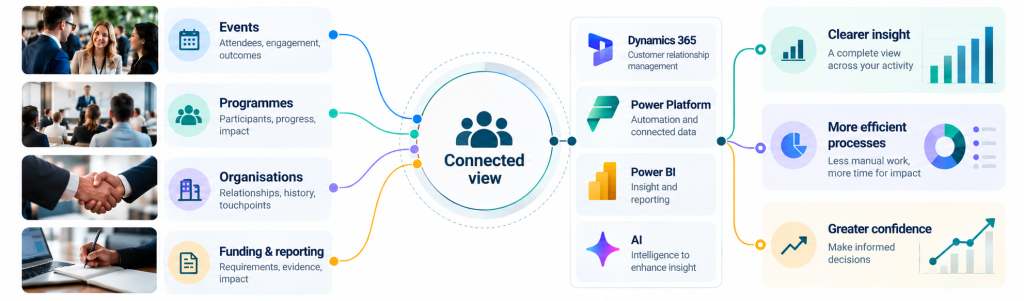
Growth shouldn’t mean losing sight of the bigger picture
For growing business networks, chambers and programme-led organisations, increasing complexity is often a natural consequence of success. More programmes create more opportunities, while greater engagement brings more relationships. Additional funding and partnerships can also lead to greater impact.
The challenge is making sure the organisation’s ability to understand what is happening keeps pace with that growth.
If reporting is becoming increasingly manual, information is spread across multiple places, or seemingly simple questions are taking too long to answer, the underlying issue may not be reporting. It may be a wider visibility problem that requires you to look at the bigger picture.
The organisations best placed to scale are those that create a connected view of their activities, relationships and outcomes before visibility becomes a significant operational challenge.
If maintaining visibility is becoming more difficult as your organisation grows, Pragmatiq can help you explore a more connected approach. By bringing your programmes, relationships and outcomes together, you can support clearer reporting and more efficient ways of working. To speak to our experts, call 01908 038110 or email info@pragmatiq.co.uk.