

Microsoft Ignite 2026: What the latest announcements mean for organisations
Microsoft Ignite 2026: What the latest announcements mean for organisations
November 25th, 2026
8 min read
Microsoft Ignite 2026 brought a significant number of announcements across AI, Copilot, business applications, data, security and Azure.
But the bigger story isn’t any individual feature. Microsoft is continuing to move AI beyond personal productivity and into the way work gets done. Copilot is becoming a place where people can delegate and collaborate, agents are taking on greater responsibility within business processes, and Microsoft is building the data, governance and infrastructure needed to support that shift. Across the announcements, Microsoft repeatedly returned to three ideas: human ambition, organisational intelligence and trust.
For organisations, these developments create new possibilities, but also new decisions around where AI genuinely adds value, what information it should be able to access, how it should be governed and how success will be measured.
Rather than covering every announcement from Ignite, we’ve focused on five key developments, alongside the wider foundations that organisations need to consider when exploring what’s next with Microsoft technology.
-
Copilot is moving further into the flow of work
One of the clearest themes from Ignite was the continued evolution of Microsoft Copilot.
Microsoft is bringing together experiences including Home, Chat and Cowork into one starting point, alongside Code and Autopilot, creating a more connected environment where people and AI can work across knowledge work and business processes.
Copilot Workspaces, available through Microsoft’s Frontier programme, brings teams, shared content and Copilot together in an ongoing collaborative space, helping people track changes, unresolved questions and actions as work progresses.
Autopilot takes this further. Designed as a persistent agent for personal productivity, it can follow up on conversations, carry out recurring work and continue projects over time without waiting for another prompt. Autopilot is currently rolling out to eligible customers through Microsoft’s Frontier programme.
The important change isn’t simply that Copilot can do more. It’s that people have more opportunities to delegate work to AI while retaining control over where human judgement is needed.
This raises a more useful question than simply how to increase Copilot adoption:
Which parts of work should people continue to own, and where could AI take responsibility for routine or repetitive activity?
Answering that requires an understanding of existing processes, employee needs and the outcomes the organisation wants to achieve. It is as much a question of business change and adoption as it is technology.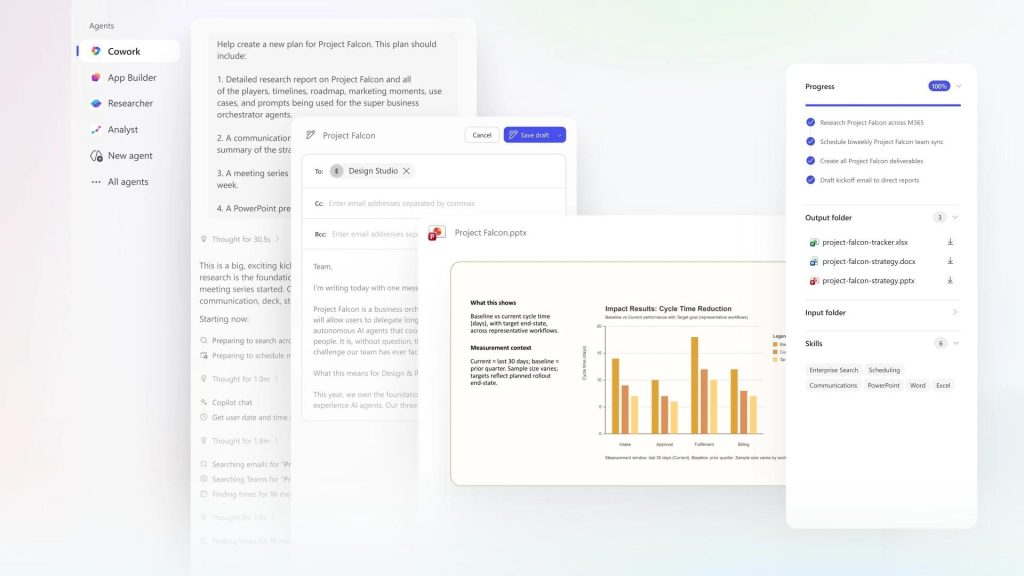
-
AI needs to understand your organisation
AI becomes more useful when it understands the organisation it is working within.
Microsoft IQ is Microsoft’s enterprise context management platform, designed to bring together the information, knowledge, expertise and ways of working that make each organisation distinctive. It connects different sources of organisational context so that AI experiences and agents can work with a richer understanding of the business.
That context spans several areas:
- Work IQ provides context around people’s work, relationships, documents, emails, meetings, chats and projects.
- Fabric IQ connects business data with trusted metrics and operational meaning.
- Foundry IQ makes unstructured organisational information and knowledge accessible to AI applications and agents.
- Web IQ brings relevant external information and real-world context into AI experiences.
The quality of enterprise AI depends on more than the model being used. If knowledge is fragmented, data is inconsistent or information is out of date, more sophisticated AI won’t automatically solve the problem.
Data and information readiness therefore need to develop alongside AI ambitions. Without trusted, well-managed context, even capable agents may struggle to produce reliable results.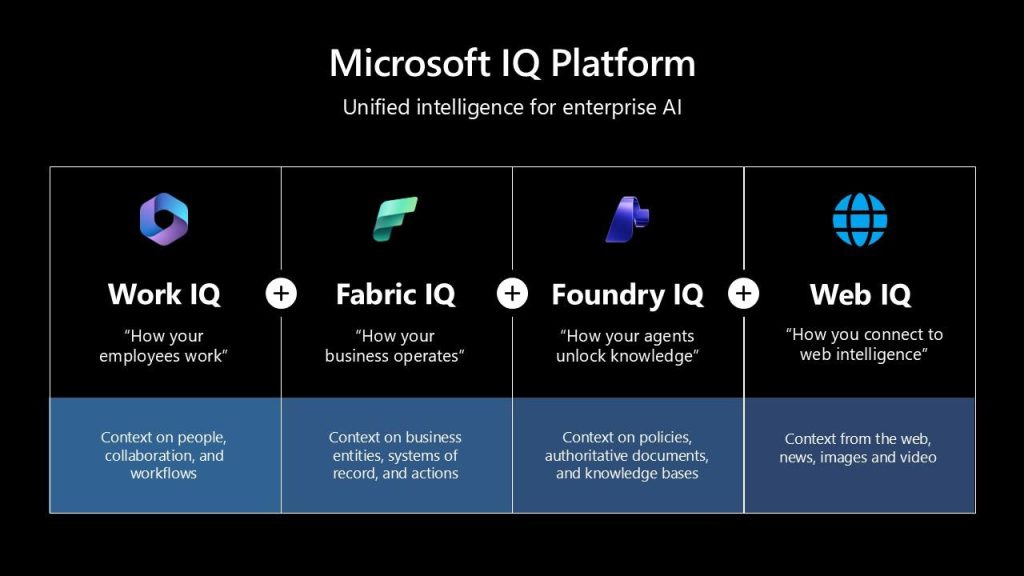
-
Agents are becoming part of business processes
Another important development from Ignite was Microsoft’s continued investment in agents that can do more than respond to individual requests.
Microsoft Copilot Studio is increasingly positioned around building and automating complete business processes across agents, workflows and apps. Microsoft has also made the Microsoft Copilot harness generally available in Copilot Studio, extending the reasoning, planning and orchestration capabilities available to agents.
Agents are also becoming more persistent. With capabilities such as memory and triggers, Microsoft is working towards agents that can take on more proactive roles in shared business processes, helping carry delegated work through to completion.
Consider a finance team preparing for a regular budget review. An agent could help gather information from approved systems, compare figures, identify outstanding questions and follow up with budget owners. Employees would still provide judgement, resolve exceptions and make decisions, but the agent could reduce the manual effort involved in preparing for the review.
The opportunity is to look beyond individual tasks and consider how the overall process could work better. That doesn’t mean adding an agent to every workflow. Organisations first need to identify where delays, manual effort or disconnected information are creating problems, while retaining human judgement and approval where they’re needed.
-
Dynamics 365 is moving closer to where people work
Ignite also showed how Microsoft is bringing more of the context and capabilities held within Dynamics 365 into Microsoft Copilot and familiar productivity tools.
Microsoft describes Copilot as a new front door to Dynamics 365, with plugins designed to bring together the knowledge, secure access and tools required for different jobs.
Several developments illustrate that direction:
- Dynamics 365 Sales plugin: Now generally available, with capabilities including account planning, customer meeting preparation, deal catch-up and pipeline prioritisation.
- Dynamics 365 Customer Service plugin: Also generally available. Together with the Sales plugin, Microsoft’s customer experience plugins now provide more than 57 business skills across sales and service.
- Dynamics 365 ERP apps plugin: Now generally available, with more than 39 finance and operations skills, bringing relevant ERP context and actions into Copilot and expanding connectivity with Excel.
The direction matters more than the number of skills. Traditionally, users have had to move between business applications to find information or complete an activity. Microsoft is increasingly bringing relevant context and actions into tools people already use, including Copilot, Teams and Excel.
For organisations, the question becomes less about how many systems employees use and more about how easily they can access trusted information and complete the right actions without unnecessary friction.
-
Governance and measurable value are becoming essential
As AI moves from providing answers to taking action, governance becomes much more operational.
Organisations need to understand what their agents can access, whose authority they operate under, how their activity is monitored and who is responsible for their ongoing management. Sensitive information, permissions and agent behaviour all need to be considered as capabilities develop.
Microsoft Agent 365 is designed to provide a central control and observability layer for enterprise agents, bringing together management, governance, security and visibility of AI activity.
Microsoft is also placing greater emphasis on the financial side of AI. Agent 365 Cost Management introduces capabilities to help organisations understand and control usage-based AI spending, including spending policies, limits and alerts. Agent 365 Business Analytics, available through the Frontier programme, is designed to help leaders connect AI spending and usage with business value using measures including success rates, user satisfaction and assisted hours.
This reflects a broader shift from measuring AI adoption to measuring its value. Organisations need clear objectives and appropriate monitoring to understand whether AI is genuinely improving the processes and outcomes it was introduced to support. Governance and measurement should therefore be considered from the outset.
The foundations for production AI are evolving too
Behind these announcements, Microsoft continues to invest in the infrastructure required to run AI reliably at scale, with developments across Microsoft Azure, Microsoft Foundry, databases and AI infrastructure.
For most organisations, the individual announcements won’t require immediate action. The important point is that moving AI into business-critical processes also requires the architecture, data, security, resilience and governance behind it to mature.
What should organisations take away from Microsoft Ignite 2026?
There were far more announcements at Ignite than any organisation needs to act on immediately. However, five themes stand out:
- AI is moving into everyday work and business processes. Copilot and agents are increasingly designed to support, perform and coordinate work rather than simply respond to questions.
- Organisational context matters. AI needs access to relevant, trusted business information and processes if it is to produce useful results.
- Processes should come before technology. The value is likely to come from improving how work is done, not introducing agents simply because the capability exists.
- Governance needs to develop alongside adoption. Identity, permissions, monitoring, ownership and security become increasingly important as agents gain greater responsibility.
- Business value needs to be demonstrated. Organisations need to consider what AI costs alongside whether it is improving efficiency, customer or employee experiences, decision-making or other measurable outcomes.
The organisations best placed to benefit won’t necessarily be those adopting the largest number of new features.
They’ll be those that identify the right business problems, understand whether their data and governance foundations are ready, support people through changing ways of working and measure whether AI is genuinely delivering value.
Explore Microsoft’s full announcements: Microsoft Ignite 2026 Book of News
Turning Ignite announcements into practical next steps
At Pragmatiq, we help organisations understand where Microsoft technologies and AI can deliver meaningful business value, whether that’s exploring Copilot, considering agents through Copilot Studio, improving Dynamics 365 or assessing wider AI readiness.
If Microsoft Ignite 2026 has prompted questions about your AI strategy, data readiness, governance or opportunities to improve existing business processes, our team can help you assess what’s relevant and determine the right next steps. Get in touch by emailing info@pragmatiq.co.uk or calling 01908 038110.